
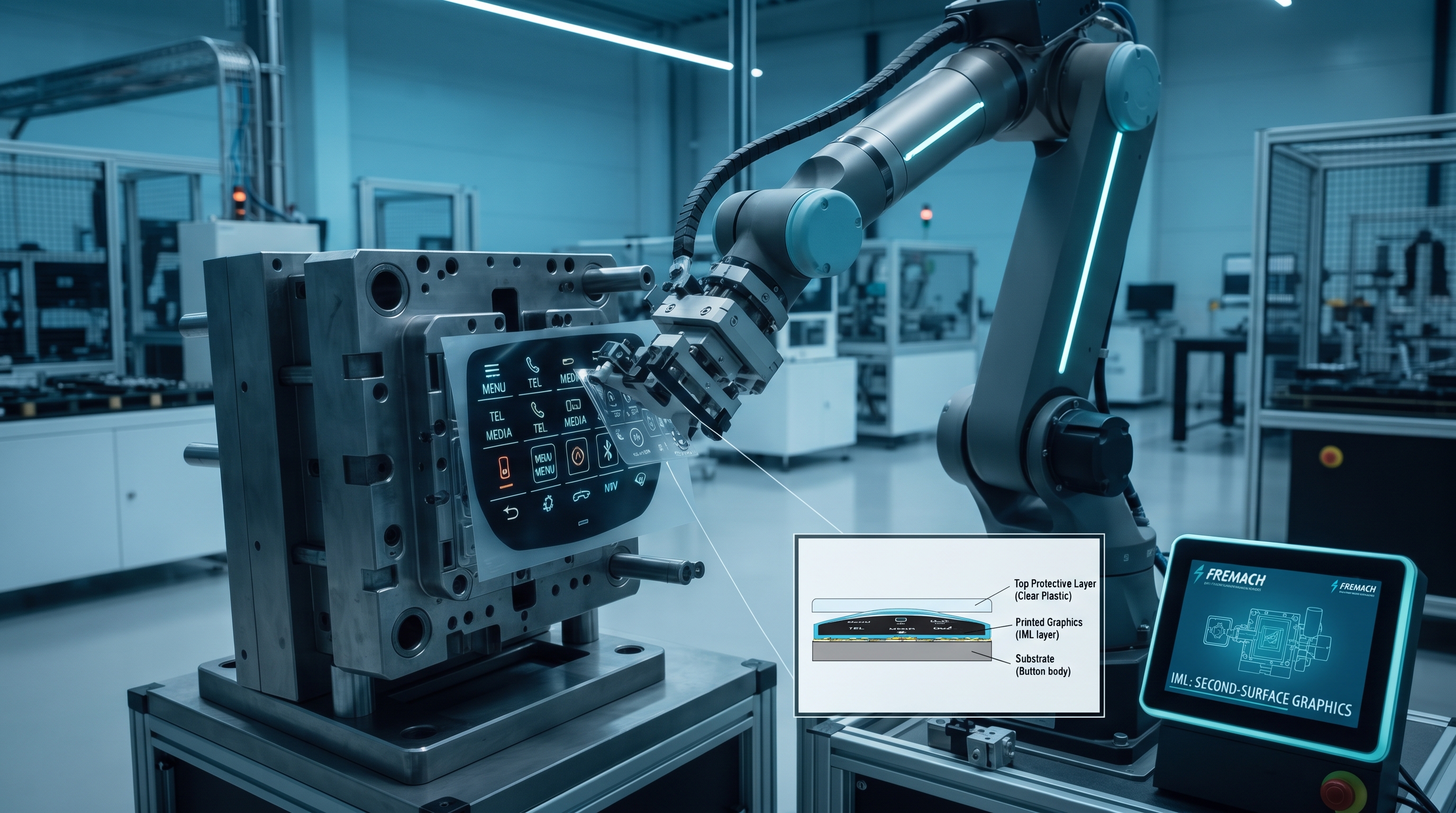
Second-surface IML: why button legends stop rubbing off
The button legend is the hardest graphic on any interior part to keep legible. It is the one decoration a fingertip lands on thousands of times across a vehicle's life, and it is rarely a clean fingertip.
Why surface-bound legends fail
Two forces attack a legend printed on the outside of a part: abrasion and chemistry. Every touch is a small abrasion cycle, and button life testing uses instruments such as the RCA abrasion wear tester precisely because surface printing loses definition under repeated friction. The chemistry is harsher still. OEM protocols do not validate with mild soap: GMW14445 covers sunscreen and insect-repellent resistance, BMW AA-0053 conditions parts against sunscreen formulations, FCA/Stellantis D23 5201 addresses creams and lotions, and VW TL 226 runs droplet tests with a battery of media (tenside solution, ammoniacal alcoholic cleaner, cleaner's naphtha, methylated spirit and synthetic sweat), with cream resistance per PV 3964. The reference sunscreens are named consumer products (Coppertone SPF 30, Neutrogena Ultra Sheer Dry Touch SPF 45, Nivea SPF 47), applied with clay strips or gauze, conditioned at temperature, then assessed by eye and by touch per DIN EN ISO 4628. Sunscreen is documented to stain and attack painted and coated surfaces. Any ink sitting on the touch surface is directly in that firing line.
Why laser marking and hard coats only go so far
Two familiar alternatives improve on plain surface ink, but each carries a constraint worth stating plainly. Laser marking becomes part of the substrate and resists abrasion, chemistry and heat far better than ink that sits on top, yet it works only by removing or changing the colour of the material: it cannot produce a full-colour icon or a cleanly transmissive backlit legend. A first-surface print sealed under a UV-cured hard coat also lasts longer, and hard-coated films reach 3H to 5H pencil hardness with super-hard-coat acrylic grades up to 9H, but the decoration still terminates at the outer surface, exactly where the sunscreen and the fingertip meet.
Second-surface IML puts the legend where nothing can reach it
Second-surface in-mould labelling changes the geometry of the problem instead of fighting it at the surface. The graphic is printed on the back (second) surface of a clear polycarbonate or acrylic film, typically 0.125 to 0.375 mm thick, and the injection resin is then shot behind it so the ink is encapsulated between the film and the moulded substrate. The protective film over the print sits on the order of 30 to 40 µm. Because the ink lives in the middle of that sandwich, friction and chemical attack cannot reach it: the surface a user touches, and coats in sunscreen, is bare hard-coated film, while the legend sits underneath. This is why notebook and phone makers moved user-interface graphics to IML for wear resistance that spray paint and pad printing could not match, and it is why the method survives automotive validation. Adhesion is verified by peel values in the 2.5 to 3.5 lbs/inch range and cross-hatch testing to ASTM D3359, checked both near and away from the gate and repeated after environmental conditioning.
At Fremach we treat second-surface IML as one step inside a larger integration rather than a standalone print. Because we mould, decorate and integrate electronics under one roof, the same film that carries the icon can be registered to a capacitive circuit behind it, so a backlit switch legend and its touch function become a single durable part instead of a printed cap over a separate switch. That is the real sourcing decision behind a legend that still reads after ten years of sunscreen, sanitiser and touch: put the graphic beneath the surface, not on it. If your team is developing a decorated or backlit control surface, bring the part or the drawing to our engineers and we will show you where second-surface IML fits, and where 2K moulding or a thermoformed overlay serves you better, for the durability margin these OEM protocols are built to expose.
Talk to our team
Stay in the loop.
Subscribe to our newsletter for new articles, project stories and technology insights. No spam, unsubscribe anytime.
Want to discuss a project?
Bring us a drawing, a target volume, or just a challenge. Our engineers review every brief and respond within two business days.