
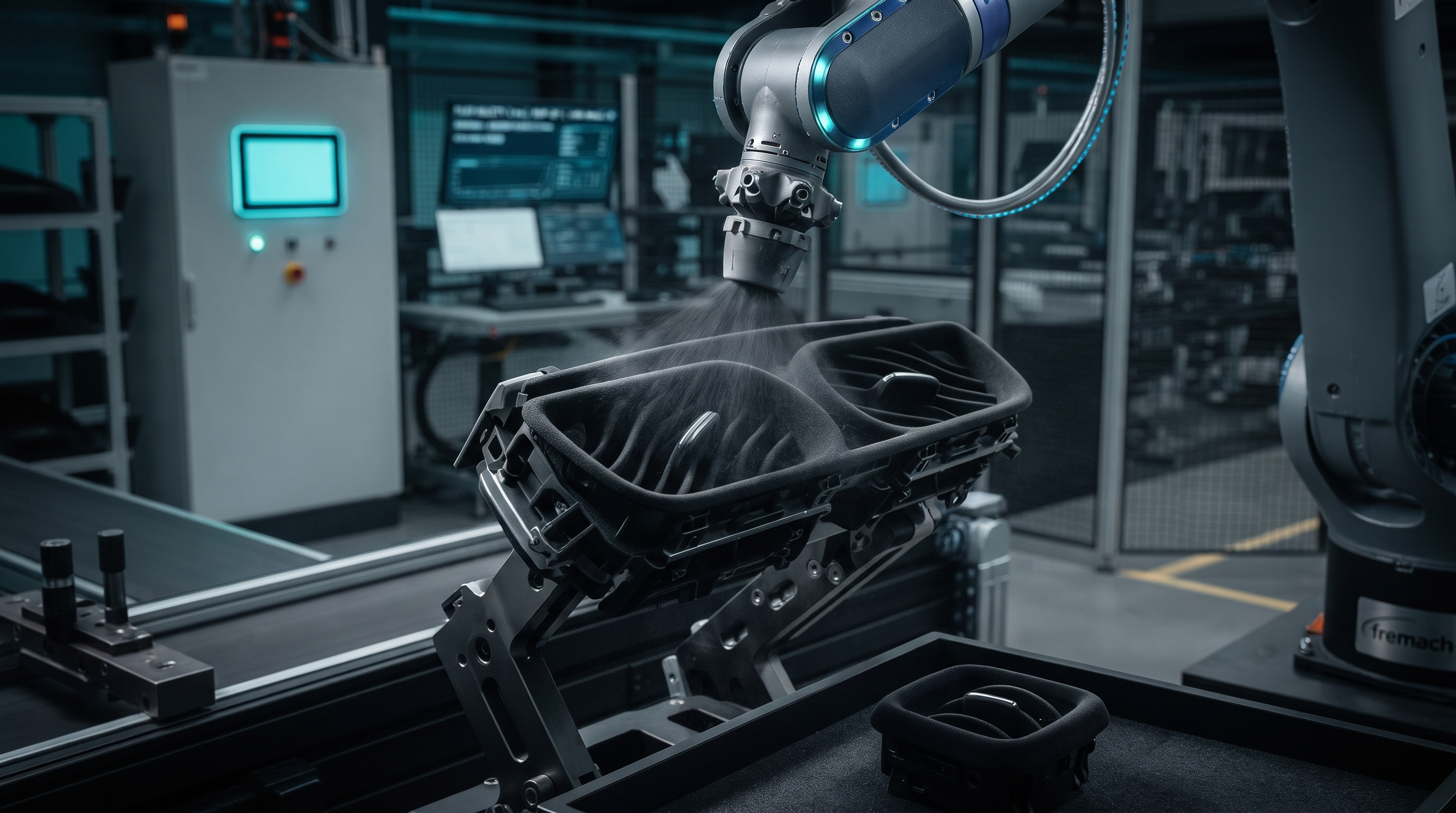
Moulded part decoration: IML vs film insert vs paint
The decoration method is one of the earliest decisions on a moulded part, and it quietly sets the ceiling on three things you cannot easily change later: how the surface looks, how long it survives handling and sunlight, and what each part costs at volume.
Paint: flexible, familiar, expensive to run
Traditional paint (primer, colourcoat, clearcoat) still handles geometry that nothing else can and gives complete colour freedom. The cost lives in the process, not the part. Solvent systems emit VOCs, and the abatement equipment to control them is a heavy capital line: roughly $1.2 million to install plus around $200,000 a year to maintain. First-pass yield sits near 85-90%. For modest volumes or a palette that changes often, paint still earns its place. For hundreds of thousands of identical parts, those economics turn against you.
In-mould labelling: the graphic disappears into the part
IML places a pre-printed flat film in the mould before injection; the melt fuses with it as the tool cools, sealing the graphic beneath the surface. Because the image sits inside the plastic, it resists scratching and fading, and the finish comes out smooth and uniform. It is the most cost-effective route for large runs of flat or gently curved parts with defined graphics (containers, control panels, appliance fascias). The trade-off is tooling: IML moulds run 25-40% more than standard tools because they carry vacuum channels, label-registration features, and automated handling. Above a certain volume, the saved secondary processing pays that back.
Film insert moulding: one step instead of three
Film insert moulding pre-decorates a flat film, thermoforms it to near-net shape, then backfills it with resin, combining print, form, and mould into a single operation. At 100,000 parts a year, published comparisons put it near $8 a part against about $11 for spray painting: a 30-50% saving once the tool is amortised, with first-pass yield of 95-98% and no VOC abatement to fund. A PC/ABS substrate with a PMMA film gives bond strength around 5.0-6.0 kgf/cm. Two failure modes deserve respect: film wrinkling if the cavity gap drifts outside 0.05-0.15mm, and ink washout when high-velocity melt scours the print (a slow first-stage fill of 30-50mm/s controls it). One hard limit: fibre content above roughly 30% tends to delaminate the film.
In-mould decoration: texture, gradient, and function
In-mould decoration transfers the decoration from a continuous film roll, and it shines where designs get complex: photographic images, gradients, three-dimensional effects, and textures that print and paint cannot reproduce. Modern versions carry haptic structure and backlighting on the same part, with reported savings of up to 60% cost and 70% CO2 versus conventional decoration on fibre-reinforced substrates. It also opens the door to in-mould electronics: capacitive controls and lit surfaces built directly into the moulded skin, a route analysts at IDTechEx expect to expand quickly.
Thermoformed overlay: decoration after the part exists
The thermoformed overlay works the other way round: a thermoformable film is vacuum-formed over an already-moulded part, and it accepts almost any substrate (plastic, metal, glass, composite). When 3D geometry is too complex for an in-mould process, or the base part is not plastic at all, the overlay wins. Wood, leather, and carbon textures come through with real depth.
Matching method to part
The decision usually resolves along a few axes: geometry complexity, production volume, durability demands, and whether the surface has to do a job beyond looking good. Flat and simple at high volume points to IML; complex but mouldable points to film insert or in-mould decoration; complex and already made points to a thermoformed overlay; low volume or a shifting palette keeps paint in play. Durability is where the material choice is proven: films and substrates should hold up through thermal cycling from -40 to 105°C and prolonged UV exposure while keeping colour shift to ΔE≤2.0.
This is a sourcing decision as much as a design one, and a supplier who runs only one decoration line will always steer you toward it. We built Fremach the other way. Under one roof we run injection and multi-component (2K/3K) moulding alongside painting, in-mould labelling, thermoformed overlays, and printing, and we assemble electronics into the decorated part when the surface has to sense or light up. That lets us recommend the method your part actually needs rather than the one we happen to own. Bring us your part or a drawing, and our engineers will work the geometry, volume, and durability targets with you to find the right decoration route.
Talk to our team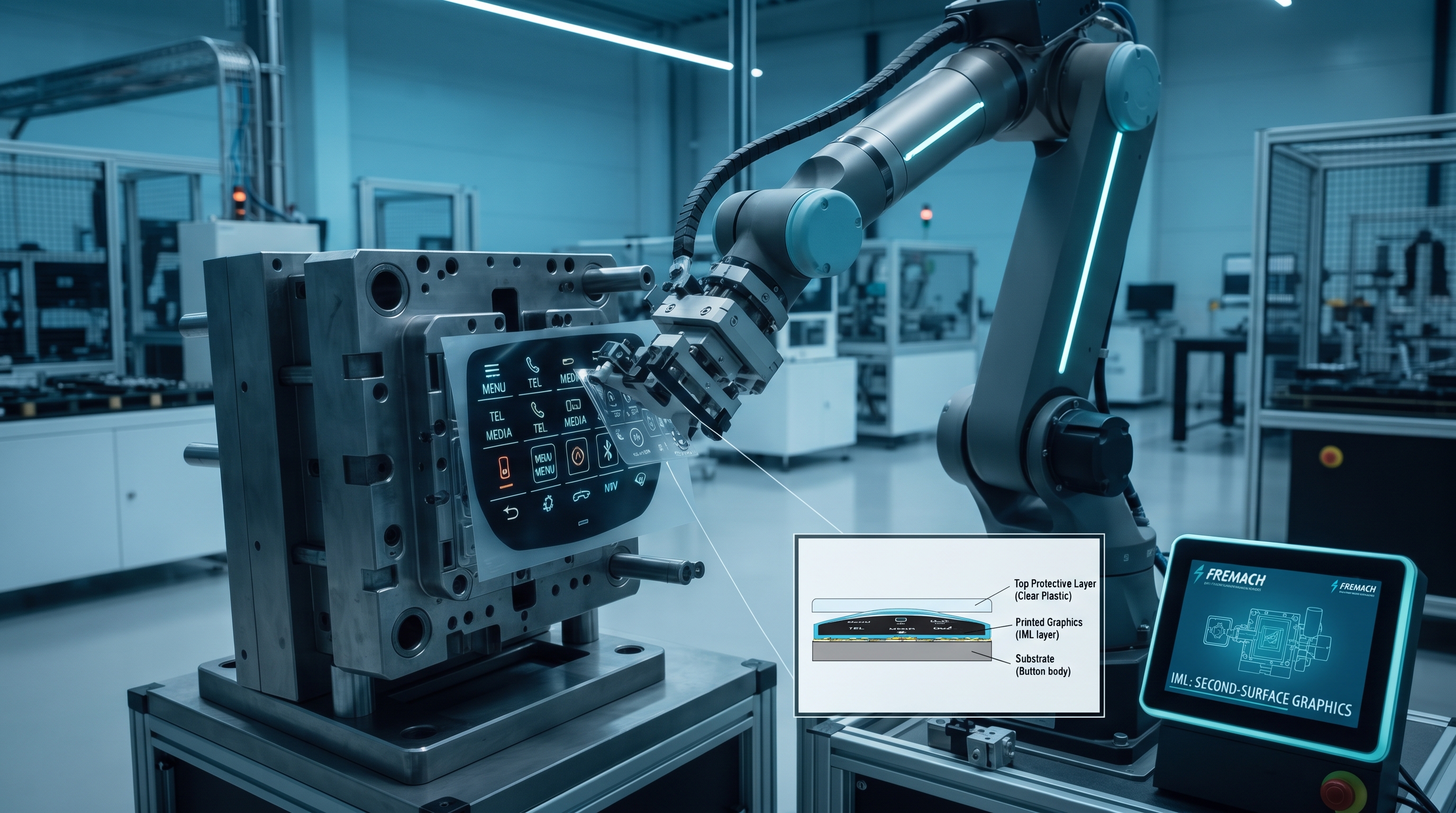
Stay in the loop.
Subscribe to our newsletter for new articles, project stories and technology insights. No spam, unsubscribe anytime.
Want to discuss a project?
Bring us a drawing, a target volume, or just a challenge. Our engineers review every brief and respond within two business days.